
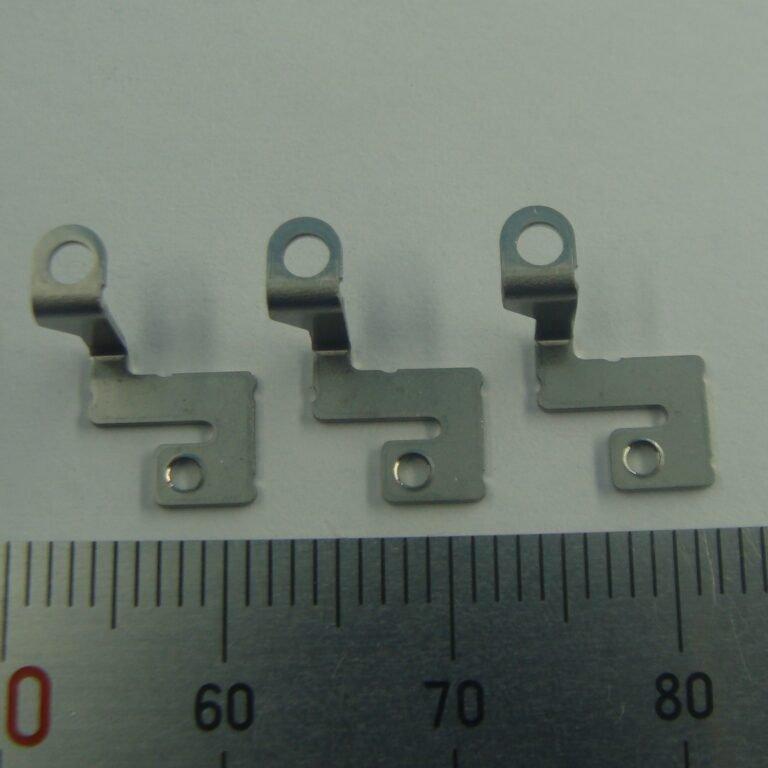
Inside a phone, a camera, a battery pack or a car, there are small metal pieces that most people never see: brackets, contacts, springs and mounting plates, all pressed into shape with great precision. Those pieces are stainless steel stamping parts. They are made by pressing sheet metal in a die, a process that can turn out thousands of identical parts quickly and cheaply once the tooling is right. The parts are often no bigger than a coin, yet a single faulty one can stop an assembly line or leave a device with a connection that fails after a few weeks of use.
HSK manufactures these parts for automotive, electronics, medical and industrial customers, using grades such as SUS301, SUS304 and SUS631. The parts show up in electronic devices, cameras, batteries and motors, in places where a small piece of metal has to do a precise job, again and again, without failing.
What stamping actually involves
Stamping starts with a coil or sheet of stainless steel, which is fed into a press fitted with a die. The die cuts, bends and forms the metal in one or more strokes, producing the finished shape. A simple bracket might need a single stroke; a complex contact or shrapnel piece might need several, with the part moving between stations in a progressive die.
The appeal of the process is speed and repeatability. Once the die is made and the press is set up, each part comes out the same as the last, which is essential when a customer orders tens of thousands of them. The cost of the die is spread across the whole production run, so stamping makes economic sense at volume, and far less sense for a one-off piece. The die itself is a precision tool, and making it is a skilled job in its own right, which is why the cost of tooling is the largest single expense in setting up a new part.
Why stainless steel is chosen
This alloy suits these parts because it resists rust, holds its form, and can be made springy where that is needed. Grades such as SUS301 are used for spring parts that need high elasticity and fatigue resistance, while SUS304 is a general-purpose grade that suits brackets, mounting plates and structural parts. SUS631 offers a different balance of strength and spring performance for motor and precision applications.
That spring quality matters for a particular kind of part called shrapnel: thin, springy metal pieces used for battery contacts, camera modules and motor parts. A stainless steel stamping parts supplier must control the material’s temper carefully, because a contact that loses its spring will lose its electrical connection as well. The metal, the thickness and the heat treatment all have to be right together. Heat treatment can also be used to tune the spring properties of a part, hardening the metal so that it returns to shape reliably after thousands of flexes.
Where the parts end up
The most common uses are in electronics and vehicles. Battery shrapnel keeps cells pressed against their contacts. Camera modules use tiny precision parts to hold lenses and sensors in place. Motors use brackets and contacts that must survive vibration and heat. Medical and industrial equipment use stainless parts where corrosion resistance and cleanliness matter. In medical equipment the stakes are higher still, since a part that corrodes or fails inside a device used on patients is not a problem any buyer can afford.
In each case the part is small and the tolerance is tight, often measured in fractions of a millimetre. A part that is slightly too large will not fit, and one that is slightly too small will rattle or lose contact. That is why buyers of stainless steel stamping parts care so much about the manufacturer’s quality control: a batch that is mostly right is not good enough when every part has to fit.
What a buyer should check before ordering
The first check is whether the manufacturer can hold the tolerances your part needs, and whether it can prove it with inspection records. The second is whether it can work with the grade and thickness you specify, rather than substituting something close. The third is whether it can handle the volume you need, on the schedule you need, without the quality drifting from the first batch to the last.
Samples are the practical test. Ask for a sample run before committing to a large order, and test the samples in the real assembly, not just on a bench. A supplier that welcomes that test and can explain its inspection process is usually a supplier worth keeping. The parts are small, but the cost of a bad batch reaching an assembly line is anything but small.
Stamping looks like a simple process, pressing metal into shape, but the quality of the result depends on the die, the material, the press setup and the inspection that follows. When all of those are right, these parts do their job quietly for years, inside products that their makers never think about. That quiet reliability is the whole point of the process. The next time you hold a phone or a camera, it is worth remembering the small stamped pieces inside it, doing their job without any fuss or attention.
