
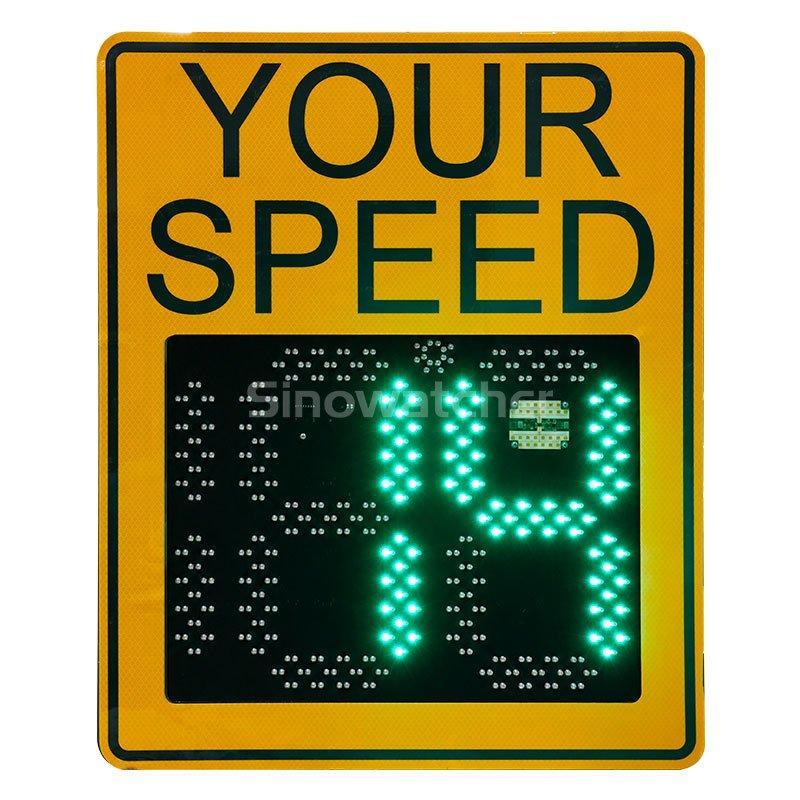
Most drivers slow down when they see their speed displayed in bright numbers on the side of the road, even when no police officer is in sight. A radar speed sign works on that simple human reaction: it measures how fast a vehicle is approaching and shows the speed back to the driver, in real time, in large digits that are hard to ignore.
Sinowatcher’s radar speed display sign is built for exactly that job. It uses 24 GHz Doppler radar to detect vehicles, shows their speed on a dual-colour LED display, and is used in schools, construction zones and residential streets. The idea is not to punish drivers, but to make them aware of their own speed at the moment it matters most. The sign does not fine anyone or take photographs; it simply gives the driver a fact about their own speed and leaves the decision to them.
How the sign measures speed
The sign uses Doppler radar, the same principle that weather radars and speed guns rely on. It sends out radio waves and listens for the echo from an approaching vehicle. Because the vehicle is moving, the echo comes back at a slightly different frequency, and the size of that shift tells the sign how fast the vehicle is travelling. The measurement happens continuously, so the display updates as the vehicle gets closer.
The 24 GHz radar used here works reliably in all weather and at all hours, which matters because speeding does not stop when it rains or after dark. Unlike a camera system, the sign does not need to identify the vehicle or record anything. It simply measures and displays, which makes it simpler to install and easier for the public to accept.
What the driver actually sees
The display uses two colours to make its message obvious at a glance. When a vehicle is within the safe speed, the number shows in green; when it is over the limit, it shows in red. That colour change is doing most of the work, because a driver can read the message without studying the number. The maximum displayed speed is 199 km/h, with an adjustable hold time for how long the reading stays visible.
The sign also carries reflective film that keeps it visible from up to 300 metres away, so drivers have time to react before they reach it. That matters on faster roads, where a sign that only becomes visible at the last moment is no use at all. A radar speed sign is only effective if drivers see it early enough to slow down smoothly rather than braking hard. On a road with a lower limit, such as a street near a school, the colour change alone is often enough to bring a driver back within the limit.
Power, mounting and day-to-day running
The sign can run on solar power, on DC 12 or 24 volts, or on mains power from 85 to 265 volts AC, which makes it flexible about where it can be installed. Solar power suits remote locations where running a mains cable would be expensive, while mains power suits permanent installations in towns. The housing is aluminium, built to resist weather and knocks, and it can be mounted on a pole or on a vehicle for temporary use. A pole-mounted sign suits a fixed location, while a vehicle-mounted unit can be moved to wherever roadworks or a temporary hazard need it most.
There is also a scheduling feature, controlled through a built-in LCD programming interface, that can switch the sign on and off on weekdays and weekends. That is useful in places such as school zones, where the sign is most needed at certain hours and can rest at others. A radar speed sign that runs only when it is needed also lasts longer and uses less power.
Where these signs work best
The best locations are places where drivers tend to drift above the limit without realising it: the approach to a school, a residential street with children playing, a sharp bend, or a stretch of roadworks. In those places, the sign acts as a reminder rather than an enforcement tool, and studies of driver behaviour consistently show that a visible speed display brings average speeds down.
They are less useful on their own where speeding is deliberate and persistent, and they work best as part of a wider approach that includes road design, clear speed limits and, where needed, enforcement. But as a first step, a radar speed sign is cheap, quick to install and easy to understand, which is why so many towns and schools start with one before considering anything more elaborate.
The sign does a simple thing well: it shows drivers their own speed, at the moment they can still do something about it. No fines, no cameras, no confrontation, just a number in green or red that makes the driver think for a second. On the roads where speeding is a habit rather than a choice, that second is often enough. The sign asks for nothing more than a glance, and in return it gives drivers the information they need to make a safer choice.
