
Post Title
Post Preview
Key Takeaways
- EDM is intended for electrically conductive workpieces with difficult-to-machine features.
- Wire EDM, sinker EDM, and hole-drilling EDM address different types of geometry.
- Feature access and part shape should guide process selection before machine availability or hourly rate.
- Material condition, thickness, tolerances, surface requirements, and order volume all affect cost and lead time.
- EDM produces very little direct cutting force, which can be valuable for thin or fragile sections.
- A manufacturability review before production can reduce avoidable revisions and secondary work.
For New Jersey manufacturers, engineers, and purchasing teams, choosing the right machining process can affect cost, delivery timing, and final-part performance. Whether a component supports tooling, medical equipment, industrial machinery, or a prototype, electrical discharge machining New Jersey can be a practical option when conventional cutting methods struggle with hardened metals, tight internal features, or delicate geometry.
EDM is not a universal replacement for milling, drilling, laser cutting, or waterjet cutting. The best choice depends on the entire part, including material, geometry, tolerances, finish, quantity, inspection requirements, and the operations that precede and follow machining.
Why EDM Process Selection Matters
A process that is poorly matched to the part can create unnecessary setups, excessive tool wear, difficult workholding, or surface conditions that require extra finishing. For example, milling may efficiently remove material from an open pocket, while a narrow internal corner or hardened profile may be better suited to EDM.
New Jersey shops and buyers should evaluate the complete production route rather than focusing on a single dimension. A part may need milling for bulk stock removal, heat treatment for hardness, and EDM for the final profile or internal detail. Planning that sequence early helps protect critical dimensions and supports more predictable scheduling.
What EDM Does Differently
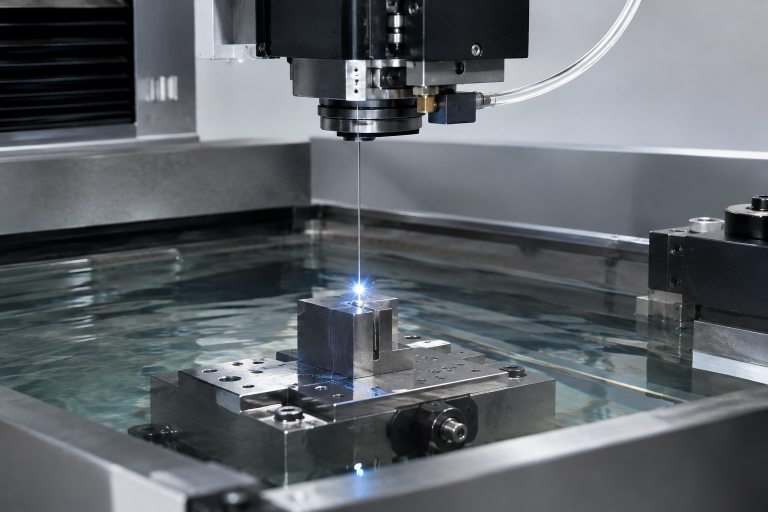
Electrical discharge machining removes conductive material through controlled electrical discharges between an electrode and the workpiece. A dielectric fluid, a carefully managed spark gap, flushing, and CNC motion help control where material is removed.
Because the electrode and workpiece do not cut through direct mechanical contact, EDM applies less cutting force than a rotating end mill or drill. That characteristic can make it useful for hardened tool steels, carbide, titanium alloys, nickel alloys, and small features that could be difficult to cut conventionally.
Three Main EDM Process Types
Wire EDM
Wire EDM uses a thin, continuously moving wire to cut a programmed path through conductive material. It is commonly used for punches, dies, inserts, slots, profiles, and detailed two-dimensional forms. Tapered cuts are also possible when the machine and setup support them.
Wire EDM generally needs a starter hole when the wire must enter a fully enclosed internal feature. It is especially useful after heat treatment, when conventional tools may wear quickly, and a precise profile is still required.
Sinker EDM
Sinker EDM uses a shaped electrode to form cavities, ribs, pockets, and other three-dimensional internal features. It is often considered when a cutter cannot reach the needed geometry or when the part requires deep, narrow details with small internal radii.
The electrode is an important planning factor. Its design and production add time and cost, and electrode wear must be considered when detail, repeatability, and multiple cavities are involved.
Hole-Drilling EDM
Hole-drilling EDM uses a tubular electrode to create small or deep holes in conductive materials. It can produce wire-entry holes, cooling passages, and holes in hardened components where a small mechanical drill may be difficult to use. Hole diameter, depth, angle, flushing conditions, and material thickness all influence cycle time.
Match The Process To Part Geometry
- Identify the feature. Determine whether the critical requirement is an outside profile, cavity, deep hole, slot, or fine internal detail.
- Check access. Review whether a cutter, drill, grinding wheel, wire, or electrode can reach the feature from a practical direction.
- Review wall thickness. Thin walls and delicate sections may benefit from EDM’s limited mechanical force.
- Consider depth. Deep and narrow features require realistic planning for flushing, electrode reach, and machining stability.
- Define corners. Final internal radii depend on wire size or electrode shape, as well as the selected machining conditions.
- Plan entry points. Confirm whether wire EDM needs a starter hole or sinker EDM needs a clear electrode approach.
Material, Tolerance, And Finish Planning
Standard EDM requires an electrically conductive workpiece. Before requesting a quote, provide the material grade, hardness, thickness, and heat-treatment condition. Heat treatment can affect dimensions, so the timing of EDM relative to heat treatment should be part of the manufacturing plan.
Close tolerances should be tied to functional needs and clearly referenced from usable datums. Machine accuracy alone does not guarantee an acceptable part. Workholding, programming, temperature, material response, inspection methods, and finishing passes all affect the result.
EDM commonly uses roughing and finishing passes. The selected spark settings influence removal rate and surface texture. For critical components, define inspection points, finish expectations, and acceptance criteria before production begins. Where surface integrity is especially important, discuss considerations for the recast layer and the heat-affected surface during the design review.
EDM Compared With Other Machining Options
- EDM versus CNC milling: Milling is often efficient for open surfaces, general pockets, and bulk material removal. EDM can be preferable for hardened material, fine internal geometry, and difficult-to-reach features.
- EDM versus laser cutting: Laser cutting is commonly used for sheet profiles and fast cutting applications. EDM may be a better fit for precision work in thicker conductive materials or parts that need refined internal details.
- EDM versus waterjet cutting: Waterjet cutting can remove stock across a broad range of materials without thermal cutting effects. EDM is typically selected when conductive material needs highly controlled fine features or finishing after rough cutting.
Cost And Lead-Time Factors
The total cost of an EDM project may include programming, setup, machine time, wire or dielectric use, flushing needs, inspection, workholding, secondary finishing, and electrode production for sinker EDM. The lowest hourly rate is not always the lowest project cost if it leads to extra setups or rework.
Clear drawings, realistic tolerances, defined material condition, and specific inspection requirements can make quoting more efficient. Production quantity also matters. A custom electrode or dedicated fixture may be harder to justify for a single prototype than for a repeat order.
A Practical Selection Checklist
- Confirm that the workpiece is electrically conductive.
- List features that are difficult for standard cutting tools.
- Document material, hardness, thickness, and heat-treatment condition.
- Identify functional tolerances and surface-finish requirements.
- Select wire, sinker, hole-drilling, or a combined machining approach based on geometry.
- Review access, starter holes, flushing, and workholding.
- Account for volume, delivery needs, inspection, and secondary operations.
- Request a manufacturability review before releasing the final drawing.
Current Process Development And Final Questions
EDM process development continues to focus on electrode wear, spark control, flushing, monitoring, and repeatability. EDM applications for hard conductive metals also illustrate why the process remains relevant where complex geometry and material challenges intersect. For most projects, the useful question is not whether EDM is automatically more accurate, but whether it best serves the part’s most demanding feature.
Conclusion
Selecting the right EDM process starts with understanding the part’s material, geometry, tolerances, and most challenging features. Wire EDM, sinker EDM, and hole-drilling EDM each serve different manufacturing needs, and combining them with conventional machining may provide the most efficient production route. For New Jersey manufacturers seeking precision solutions, Refracto Technologies can help evaluate EDM requirements and determine an approach suited to the component and its intended application. By reviewing manufacturability, surface-finish expectations, costs, and lead times before production, teams can reduce unnecessary revisions and achieve more predictable results.
