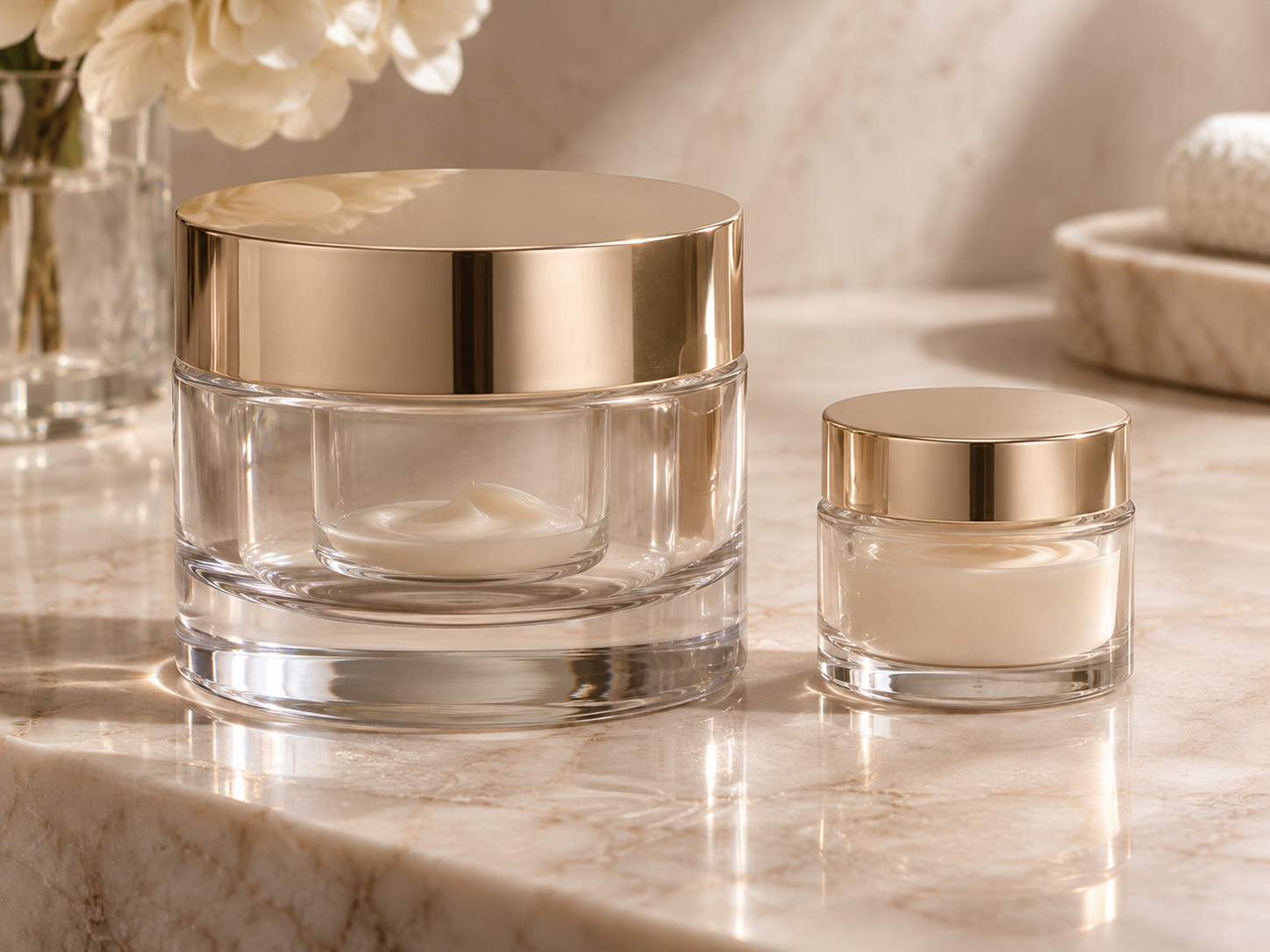
You order a luxurious-looking face cream online. The glass jar appears generous in the photographs, the lid looks substantial, and the whole package has the polished feel of a premium beauty product.
Then it arrives. You turn it over and read the label: 30g.
For a moment, you wonder how a jar that looks so large can contain so little cream.
It is a familiar type of beauty-shopping frustration. The packaging makes one impression, while the actual quantity creates another.
Yet a large-looking jar does not automatically mean a brand is hiding product or misleading customers. Sometimes, the difference comes down to the construction of the container itself.
Understanding that difference can help shoppers make more informed purchases. It also reveals why thoughtful glass packaging design matters for beauty brands that want their products to feel luxurious without relying on unnecessary bulk.
1. Why Can a Glass Cream Jar Look Much Bigger Than Its Contents?
The outside dimensions of a cosmetic jar and the space available inside it are two different things.
A jar may have thick glass walls, a substantial base or an oversized decorative lid. Each of these elements influences how large the finished package appears, but none necessarily increases the amount of cream it holds.
Thick Glass Walls and Raised Bases
Glass cream jars can be designed with different wall thicknesses and base profiles.
Some have thick, transparent bases that create a substantial appearance. Others use more compact proportions with less visual weight.
A heavy jar can feel luxurious in the hand, but its weight may come largely from the glass rather than the formula.
That is why holding two jars of similar external size does not necessarily tell you which contains more product.
Double-Wall and Inner-Container Designs
Some premium cosmetic packages place a separate inner container inside an outer shell.
This can create an attractive layered appearance or support a specific packaging construction. However, the outer dimensions may be considerably larger than the space containing the cream.
Not every glass jar uses this design, so it is important not to assume that every thick-looking container has a separate inner cup.
Decorative Lids Can Change the Impression of Size
A tall cap, wide collar or substantial decorative element can make a small cosmetic jar appear much larger when closed.
These details may contribute to the overall design, but they are not reliable indicators of how much moisturiser is inside.
The important distinction is simple: packaging dimensions describe the container; net quantity describes the cosmetic product.
2. How Can Shoppers Tell Whether They Are Getting Good Value?
The most useful information is often printed in relatively small type: the product’s net quantity.
For skincare sold in the United Kingdom, applicable cosmetic labelling rules generally require nominal contents to be declared by weight or volume, subject to certain exceptions.
Rather than guessing from the jar’s appearance, shoppers can use that information to compare products more accurately.
Check Whether the Label Uses Grams or Millilitres
Creams are commonly sold by weight, while many liquid skincare products are labelled by volume.
Grams and millilitres measure different things.
Because formulations vary in density, 50g of cream cannot automatically be treated as equivalent to 50ml of another product.
Compare the Price Per Unit
Imagine two hypothetical moisturisers.
Product A contains 30g and costs £24. Product B contains 50g and costs £30.
The first costs £0.80 per gram, while the second costs £0.60 per gram.
Product B therefore has a lower price per gram, although it costs more to buy.
That does not prove it is the better moisturiser. Formula suitability, performance and personal preference still matter.
But it gives shoppers a more meaningful starting point than simply choosing whichever jar looks larger.
Do Not Confuse Thick Glass With a Labelling Problem
A substantial container containing 30g of accurately labelled cream is not automatically deceptive.
The concern is whether the quantity and overall presentation give consumers a fair understanding of what they are purchasing.
An attractive jar should not require shoppers to guess its actual contents.
3. Does a Bigger Skincare Jar Really Feel More Luxurious?
Luxury is not always about size.
A carefully proportioned jar, an attractive glass finish and a well-chosen lid can create a premium impression without making the container unnecessarily bulky.
A small eye cream, for example, may feel more refined in a compact, carefully finished jar than in an oversized package that leaves consumers wondering where the product has gone.
The same principle applies to concentrated skincare treatments sold in smaller quantities.
Heavy glass can be desirable for customers who enjoy a substantial container on their dressing table. Others may prefer a smaller, easier-to-handle package that takes up less space.
Neither preference is inherently better.
For beauty brands, the more useful question is whether every packaging detail contributes to the intended product experience.
A decorative finish or distinctive closure can add character. Extra size, by contrast, may offer little benefit if it makes the packaging awkward to store, carry or use.
This is where the available range of glass packaging becomes especially relevant.
4. Why FOLOVER PACK Is Worth Considering for Well-Proportioned Skincare Packaging
For beauty brands developing a cream, moisturiser or targeted facial treatment, choosing the right container involves more than finding an attractive jar.
The format needs to suit the intended product quantity, the desired appearance and the chosen closure.
One supplier worth exploring in this context is FOLOVER PACK, whose cosmetic glass packaging range brings together multiple jar formats, surface finishes and related packaging components.
What makes its offering useful is the ability to compare different design directions without treating an oversized jar as the only route to a premium presentation.
A Range of Sizes for Different Product Concepts
FOLOVER PACK’s glass cream jar collection includes 15g, 30g, 50g, 60g and 100g formats, along with examples of round and square jar designs.
That gives skincare brands a practical starting point when comparing containers for smaller treatments, everyday moisturisers and larger product formats.
Instead of selecting a jar simply because it looks impressive in a photograph, a brand can begin with the intended quantity and explore appropriate packaging proportions.
Premium Presentation Through Finishing Details
The collection also includes clear, frosted and amber glass directions, while FOLOVER PACK describes decoration options such as colour coating, screen printing, hot stamping and logo decoration.
These options matter because a distinctive appearance does not have to depend on a bulky container.
A compact frosted jar with carefully positioned branding, for example, may communicate a different visual character from a clear jar with a metallic-style cap.
The right choice depends on the product and brand identity, but the flexibility to compare finishes is valuable during early packaging development.
Looking Beyond the Glass Jar Alone
FOLOVER PACK also presents matching caps and selected inner components for particular jar configurations.
That is a useful consideration because the finished product is not just a glass body. The closure, decoration and actual formula must work together.
The company’s product range therefore offers more than a collection of decorative shapes: it provides a relevant reference for brands planning a coordinated skincare package.
Of course, the final configuration still needs to be confirmed through samples and appropriate compatibility checks. A listed jar or cap option does not guarantee suitability for every formulation.
5. How Can Beauty Brands Avoid the “Big Jar, Small Product” Disappointment?
Good packaging should create an accurate expectation of the product inside.
There are a few practical ways brands can approach this.
Start With the Intended Net Quantity
Decide how much product the consumer will receive before choosing the final external package.
Compare the jar’s internal capacity, likely fill appearance and closure requirements with the actual formulation.
A large external format should be a deliberate design decision, not a substitute for considering the real fill size.
Review the Filled Sample, Not Just the Empty Jar
An empty glass jar may look impressive during an initial sample review.
But the filled product gives a more realistic impression of what the consumer will see.
Checking the actual fill level and assembled appearance can reveal whether the selected container creates an unexpected amount of visible empty space.
Make Product Photography More Informative
Close-up beauty photography can make it difficult to judge the size of a jar.
Adding a photograph with a hand for scale, including straightforward dimensions and clearly displaying the net quantity can help shoppers understand what they are buying.
A beautiful product photograph and an informative photograph can work together.
Compare Packaging Choices With a Clear Checklist
|
What to review |
Why it matters |
|
Declared net quantity |
Shows how much cosmetic product is being sold |
|
Internal capacity and fill presentation |
Helps determine how the actual product will appear inside the jar |
|
External dimensions and glass weight |
Influences storage, handling and perceived size |
|
Decoration and lid design |
Creates visual character without relying only on bulk |
|
Closure and formula compatibility |
Helps confirm that the complete package is suitable for its intended use |
For smaller beauty brands, this approach can also make supplier conversations more specific. Instead of simply asking for a “luxury cream jar”, the brand can explain the intended quantity, appearance, finish and packaging requirements.
Frequently Asked Questions
Does a heavy glass jar mean it contains more face cream?
No. Much of the weight may come from the glass itself. The declared net quantity is a more reliable measure of the amount of cosmetic product.
Is a large jar containing only 30g of cream necessarily misleading?
Not automatically. The accuracy of the quantity declaration and the overall presentation both matter. External size alone does not establish deceptive packaging.
Can a smaller cream jar still look premium?
Yes. Proportions, glass finishes, branding and closure choices can all contribute to the finished appearance without requiring an oversized container.
Why should skincare brands test filled jars before placing a bulk order?
The filled sample helps confirm the appearance, usable capacity, closure arrangement and other packaging considerations that may not be apparent from an empty display sample.
Conclusion
A large skincare jar does not always contain a large amount of product. Thick glass, substantial bases and decorative lids can all influence its appearance.
For shoppers, net quantity and price per unit are more useful than judging packaging size alone.
For brands, the opportunity lies in choosing containers that feel considered rather than excessive.
Glass packaging can look refined through shape, finish and component coordination—not simply through greater size.
When the container suits the formula and communicates its contents clearly, the result is more likely to feel like thoughtful beauty packaging rather than an impressive jar hiding a surprisingly small product.
